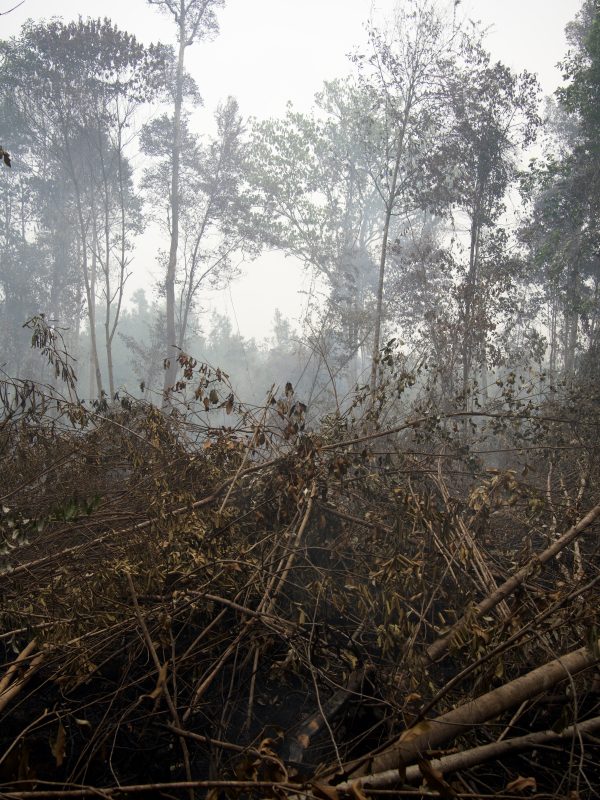
A field report on forest fires, disappearing habitat, and the growing cost of protecting one of the world’s most extraordinary rainforests.
By orangutantour.co | October 2026
The forest does not have to disappear beneath a wall of flames to begin dying.
Sometimes, the first warning is a change in the air. Smoke settles over rivers and villages. The morning sky loses its familiar blue. The forest becomes quieter, and animals that once moved freely beneath the canopy begin searching for food and shelter elsewhere.
Across Indonesian Borneo, known locally as Kalimantan, the 2026 forest-fire season has brought renewed attention to a crisis that reaches far beyond the boundaries of individual fires. Forests are burning, peatlands are under pressure, and conservationists are confronting the difficult task of protecting wildlife in landscapes increasingly exposed to drought, fire, and human activity.
For the Bornean orangutan, a species already threatened by habitat loss and fragmentation, these fires represent another serious challenge to its survival.
Recent reports from conservation organizations and Indonesian authorities have documented fires affecting important wildlife habitats, alongside rescue operations for orangutans found in fire-affected areas. The consequences extend beyond the immediate destruction visible from the ground. They can reshape the places where orangutans feed, sleep, reproduce, and raise their young.
The question is no longer simply how many hectares have burned. It is what remains for wildlife when the smoke finally clears.
Indonesia’s Forest Fires in 2026: A Crisis Beyond the Flames
Forest and land fires are a recurring environmental problem in Indonesia, particularly during prolonged dry periods. In 2026, worsening dry conditions and El Niño-related concerns have added pressure to fire-prone landscapes across the archipelago.
On 13 October 2026, Indonesia’s Ministry of Forestry reported an increase in high-confidence satellite-detected hotspots in several priority provinces, including Central Kalimantan. These detections are important warning signals, although a hotspot is not automatically proof of an active forest fire; satellite observations must be interpreted and verified alongside other information.
The distinction matters because the scale of a fire cannot be understood from a single satellite image or hotspot count. Fire location, vegetation type, weather conditions, accessibility, and the presence of nearby communities all influence how an incident develops.
In Kalimantan, the stakes are particularly high because the island contains extensive tropical forests, peat-swamp ecosystems, and habitats supporting some of Southeast Asia’s most threatened wildlife.
When a fire reaches these landscapes, its effects can extend well beyond the visibly burned area. Smoke can travel considerable distances, while damage to vegetation and water systems can continue to affect the ecosystem long after the flames have been extinguished.
For communities living near the forest, the consequences are immediate and personal. Smoke affects daily life, outdoor activities become more difficult, and transportation can be disrupted when visibility deteriorates.
For wildlife, there is often no clear boundary between a safe place and a dangerous one.
Why Peatland Fires Are So Difficult to Extinguish
One of the greatest challenges in fighting fires in Kalimantan is the presence of peatlands.
Peatlands develop over long periods as partially decomposed plant material accumulates in waterlogged conditions. These landscapes store enormous quantities of organic carbon and support specialized ecosystems, including peat-swamp forests that provide habitat for orangutans and many other species.
Under natural, wet conditions, peat is less susceptible to burning. However, when prolonged drought or drainage lowers the water table, the ground can become increasingly vulnerable to fire.
Once ignited, a peat fire may spread through organic material beneath the surface. The visible flames may disappear while heat and combustion continue underground, making the fire difficult to detect and extinguish completely.
This is one reason peatland fires can be so persistent.
Firefighters may need to locate underground burning areas, access difficult terrain, and apply sufficient water to extinguish smouldering material rather than simply suppressing flames above ground.
The challenge becomes greater when dry weather continues and water sources become less accessible.
Peat fires also create a serious climate problem. Carbon accumulated in the ground over long periods can be released into the atmosphere when peat burns. The resulting emissions contribute to climate change, while the loss of vegetation and changes in water management can leave the landscape more vulnerable to future fires.
The damage therefore operates in two directions: a warming and drying environment can increase fire risk, while peat fires release additional greenhouse gases.
For Kalimantan, protecting peatlands is not simply a matter of conserving trees. It means protecting the water systems that keep entire landscapes functioning.
What Happens to Orangutans When Their Forest Burns?
Bornean orangutans (Pongo pygmaeus) spend much of their lives in trees. Forest canopies provide food, shelter, and places to build sleeping nests. Their survival depends on access to suitable habitat across landscapes large enough to support their needs.
When fire damages that habitat, the effects are not limited to animals caught directly in the flames.
1. They lose food and shelter
Orangutans depend on a varied diet that includes fruit, leaves, flowers, bark, and other forest resources. The availability of these foods changes naturally throughout the year, but a major fire can remove vegetation and disrupt the local food supply.
Trees that provide fruit or suitable nesting sites may be damaged or destroyed. Even when an individual orangutan survives, the forest around it may no longer provide enough food or shelter.
Recovery can take years, depending on the severity of the fire and the condition of the surrounding landscape.
2. Smoke affects their health and behaviour
Smoke is not merely a visibility problem. It contains fine particles and gases that can affect respiratory health.
Research published in the journal Scientific Reports examined wild Bornean orangutans exposed to smoke during the 2015–2016 fire period in Central Kalimantan. Researchers found changes in their activity patterns, including increased resting and reduced travel, as well as physiological signs consistent with increased energetic stress after the smoke period.
The study involved a small number of adult males, so its findings should not be treated as a complete assessment of every orangutan population. Nevertheless, it provides important evidence that wildfire smoke can affect orangutans even when they are not directly caught in a fire.
An animal does not need visible burns to experience the consequences of a forest fire.
3. They may be forced into dangerous areas
As forest resources disappear, orangutans may move into remaining patches of vegetation or toward areas occupied by people.
These movements can bring them into contact with roads, agricultural land, plantations, and settlements. Such encounters can create additional risks, including conflict with people and the possibility of injury or capture.
Fragmented habitat makes the problem worse. A surviving patch of forest may offer temporary shelter but still be too small or isolated to support a population over the long term.
For a species that naturally spends most of its life in the forest, losing access to connected habitat can be as consequential as losing individual trees.
4. Mothers and young face a particularly difficult future
Orangutans reproduce slowly, and young animals depend on their mothers for an extended period.
When a forest is damaged, mothers must continue finding food while protecting their offspring and navigating an unfamiliar or deteriorating environment. The loss of productive feeding trees and safe sleeping locations can make this task more difficult.
If an adult female dies or becomes separated from her infant, the consequences can be especially severe.
Rescue and rehabilitation may help some displaced animals, but these interventions cannot fully replace the ecological conditions required for a wild orangutan population to survive.
The strongest protection remains a healthy, connected forest in which orangutans can live without being pushed into increasingly dangerous surroundings.
A Rescue Operation Reveals the Human Cost of Habitat Loss
The consequences of the 2026 fires have already been documented through wildlife rescue efforts in West Kalimantan.
In August, an adult male orangutan later known as Sampurna was found weak in an oil-palm plantation near a fire-affected area in Ketapang. A rescue team from the West Kalimantan Natural Resources Conservation Agency and the Indonesian Nature Rehabilitation Initiative Foundation (YIARI) responded to the case.
The animal showed signs of respiratory distress and received emergency veterinary care. Despite the intervention, Sampurna later died.
The case illustrates a difficult reality: reaching an animal in distress does not guarantee that it can be saved.
In October, conservationists also reported relocating eight endangered orangutans to protected forest in West Kalimantan following habitat damage associated with fires. The group included three mothers with infants and two adolescent males.
These interventions are essential when animals face immediate danger. They also demonstrate the limitations of rescue as a conservation strategy.
Moving an orangutan requires more than finding a vehicle and transporting it to another forest. Conservation teams must assess its health, determine whether it can survive independently, identify suitable habitat, and consider the ecological needs of the receiving area.
A release site must offer food, water, shelter, and enough suitable forest to support the animals without creating additional pressure on resident wildlife.
Rescue can prevent individual deaths, but it cannot restore an entire burned ecosystem overnight.
The long-term challenge is to ensure that orangutans still have somewhere safe to live before another emergency forces them out of their habitat.
Why the Damage Continues After the Fire Is Out
A burned forest can look deceptively quiet.
The flames have disappeared, smoke begins to disperse, and the immediate emergency may appear to be over. But the ecological recovery process is only beginning.
Some trees survive while others die gradually from heat damage. Plants that provide food may take years to recover. Soil conditions can change, and the loss of vegetation may influence how water moves through the landscape.
In peatlands, damage to the hydrological system is especially concerning. When peat becomes drier, the risk of future fires can increase. Repeated burning can further degrade vegetation and the conditions needed for natural forest regeneration.
The consequences are not uniform. Some areas may recover relatively quickly, while severely burned or repeatedly disturbed landscapes can remain degraded for much longer.
For orangutans, the difference between a forest that looks green from a distance and one that genuinely supports wildlife is significant.
A functioning habitat must offer more than tree cover. It must provide a sufficient supply of food, safe nesting locations, water, and connections to other suitable forest areas.
If those elements disappear, an area may remain visibly green without offering the same ecological value it once did.
This is why conservation work cannot end when the fire is declared extinguished. Monitoring, habitat restoration, protection against renewed burning, and the recovery of natural water systems are all part of the longer process.
The Connection Between Forest Fires, Land Use, and Climate
Forest fires have multiple causes, and it would be misleading to attribute every incident to a single factor.
Weather conditions influence how easily vegetation ignites and how rapidly a fire spreads. El Niño can contribute to drier conditions in parts of Indonesia, although its effects vary by location and season.
Human activities also matter. Land clearing, accidental ignitions, drainage of peatlands, and inadequate fire prevention can increase the likelihood that a fire starts or becomes difficult to control.
In landscapes where forest and agricultural land meet, the consequences of a fire can depend heavily on how land is managed and how quickly an ignition is detected.
This makes prevention essential.
Fire prevention requires more than deploying firefighting teams during the driest months. It also involves maintaining appropriate water levels in peatlands, monitoring vulnerable areas, enforcing regulations, improving early-warning systems, and working with local communities to reduce ignition risks.
Companies and land managers must also take responsibility for preventing fires on land under their control.
At the same time, climate change and land-use decisions should not be treated as interchangeable explanations. They interact, but each requires different responses. Reducing greenhouse gas emissions alone will not prevent every fire, just as extinguishing a fire will not solve the underlying problem of degraded peatlands.
Effective conservation needs to address immediate emergencies and the conditions that make those emergencies more likely to recur.
Is Tanjung Puting National Park Also at Risk?
For travellers interested in orangutans, one important question is whether forest fires threaten the places where wildlife encounters take place.
Tanjung Puting National Park, in Central Kalimantan, is one of Indonesia’s best-known destinations for observing orangutans in their natural environment. Visitors commonly explore its waterways by traditional wooden riverboat, known as a klotok, travelling through forested river corridors and visiting established sites associated with orangutan conservation.
The wider region contains peat-swamp forests and other ecosystems that can be vulnerable to prolonged dry conditions and fire.
However, it is important to distinguish a regional fire emergency from the actual condition of a particular destination.
A hotspot detected somewhere in Central Kalimantan does not establish that Tanjung Puting National Park is burning. Likewise, a report of smoke in one district does not prove that every river route or visitor site is affected.
Conditions can change quickly, and current information should come from park authorities, local operators, and relevant conservation teams.
Before travelling during a period of severe haze, visitors should confirm whether their planned route is operating, ask about air quality and visibility, and follow any official restrictions or safety advice.
If a trip is postponed or a route is changed for safety reasons, that decision should be understood in the context of local conditions rather than assumptions about the entire island.
Responsible wildlife tourism depends on accurate information, respect for local guidance, and the willingness to adjust plans when environmental conditions require it.
Can Responsible Orangutan Tourism Help Protect the Forest?
Tourism alone cannot stop forest fires. It cannot replace effective law enforcement, sound land management, peatland restoration, or adequately funded conservation programmes.
Nevertheless, responsible tourism can contribute to a broader conservation economy.
When wildlife tourism is managed carefully, it can support local employment, provide income for guides and boat crews, create opportunities for community-based businesses, and strengthen the economic case for keeping natural habitats intact.
Visitors can also learn about the ecological importance of peat-swamp forests and the challenges faced by orangutans beyond the moments they see them in the trees.
These benefits are not automatic. They depend on how tourism is organised, where the money goes, and whether wildlife and local communities are treated with respect.
Responsible visitors can make better choices by selecting operators that follow park regulations, respect wildlife viewing distances, minimise waste, and communicate honestly about environmental conditions.
They should never demand closer encounters with wild orangutans or encourage guides to approach animals simply to obtain a photograph.
An orangutan is not a performer, and the forest is not a stage built exclusively for visitors.
The purpose of a responsible wildlife encounter is to observe an animal in its natural environment without compromising its safety or behaviour.
Tourism should help people understand why the forest matters. It should never come at the expense of the very habitat that makes the experience possible.
What Needs to Happen Next?
The response to Indonesia’s forest-fire crisis must extend beyond emergency firefighting.
Several priorities are particularly important for orangutan conservation.
Protect remaining natural forest. Preventing further habitat loss reduces the pressure on wildlife populations already affected by fire and fragmentation.
Keep peatlands wet. Appropriate water management and peatland restoration can reduce the vulnerability of these carbon-rich ecosystems to fire.
Strengthen early detection and response. Satellite monitoring, ground verification, local reporting, and rapid intervention can help authorities identify and respond to fires before they expand.
Support local communities. Prevention programmes are more effective when communities have access to practical alternatives to burning for land preparation, adequate resources, and a meaningful role in landscape management.
Rescue wildlife when necessary. Veterinary treatment, rehabilitation, and carefully planned relocation can be critical for animals facing immediate danger. These measures must be accompanied by long-term habitat protection.
Monitor recovery. Assessing vegetation, food availability, water conditions, and wildlife populations helps conservationists understand whether a burned landscape is recovering or remains vulnerable.
Finally, accountability matters. Fire prevention and response require clear responsibilities, effective enforcement, and transparent information about incidents and their consequences.
Without those measures, each new fire season risks becoming another cycle of emergency response followed by renewed damage.
The Forest Is More Than a Destination
For many travellers, Borneo begins as a dream of seeing an orangutan in the wild.
Perhaps it is the sight of an adult moving through the canopy, a mother carrying her infant, or an animal pausing above a river while a wooden boat drifts quietly below.
Those encounters can be unforgettable. But they represent only a small part of a much larger living system.
Behind every sighting is a forest that provides food, shelter, water, and the space required for wildlife to survive. Beyond the riverbanks are communities whose lives are closely connected to the land. Beneath the forest floor are peat deposits that store carbon and help regulate the wider environment.
When a forest burns, all these connections are placed under pressure.
An orangutan that disappears from a familiar feeding tree may not simply have moved deeper into the forest. It may be searching for food in a damaged landscape. A river covered in haze may reflect conditions affecting people and wildlife far beyond the visible fire. A patch of burned ground may represent years of ecological recovery still to come.
The tragedy of a forest fire is therefore not measured only in flames, smoke, or hectares lost. It is also measured in the future opportunities that disappear when wildlife loses the habitat it needs.
Kalimantan’s forests remain vital to the survival of orangutans, the wellbeing of local communities, and the conservation of one of the world’s great tropical ecosystems.
Protecting them requires more than sympathy for animals caught in an emergency. It requires sustained action to prevent fires, restore damaged landscapes, and ensure that the remaining forests can continue to support life.
When the smoke clears, the real question is not whether the forest looks green again.
It is whether the forest can still sustain the life that depends on it.
Frequently Asked Questions About Forest Fires in Borneo
Why do forest fires occur in Kalimantan?
Fires can result from human activities, land clearing, accidental ignitions, and dry environmental conditions. Drained peatlands and prolonged drought can make fires more difficult to control. The causes of individual incidents need to be established through investigation.
How do forest fires affect orangutans?
Fires can destroy food sources and nesting trees, fragment habitat, expose orangutans to smoke, and force them into areas closer to people. Research has also documented changes in the activity and energetic condition of wild Bornean orangutans during and after severe smoke exposure.
Are peatland fires more difficult to extinguish?
Yes. Peat can smoulder beneath the ground, allowing combustion to continue even after visible flames have disappeared. Effective suppression may require extensive water application and careful monitoring of underground burning areas.
Is Tanjung Puting National Park safe to visit during the fire season?
Safety depends on the conditions at the time of travel, including the location of fires, air quality, visibility, and official park guidance. Check current information with park authorities and your local tour operator before departure.
Can orangutans survive after their forest burns?
Some orangutans may escape and survive if suitable habitat remains nearby. However, survival depends on the severity of the damage, access to food and shelter, smoke exposure, and the availability of connected forest. Some animals require rescue and veterinary treatment.
How can travellers help protect orangutan habitat?
Choose responsible wildlife-tour operators, follow park rules, avoid disturbing wild animals, minimise waste, and learn about the conservation challenges affecting the places you visit. Supporting credible habitat-protection and community conservation initiatives can also contribute to long-term efforts.
About orangutantour.co
At orangutantour.co, we believe that experiencing Borneo’s wildlife should go hand in hand with understanding the forests that sustain it. Learning about orangutans means looking beyond individual encounters to the wider landscape, the people who live alongside it, and the conservation challenges that will shape its future.
Editorial note: This article uses publicly reported information available as of 14 October 2026. Conditions at individual fire sites and visitor destinations may change; readers should consult current official updates for operational and safety decisions.