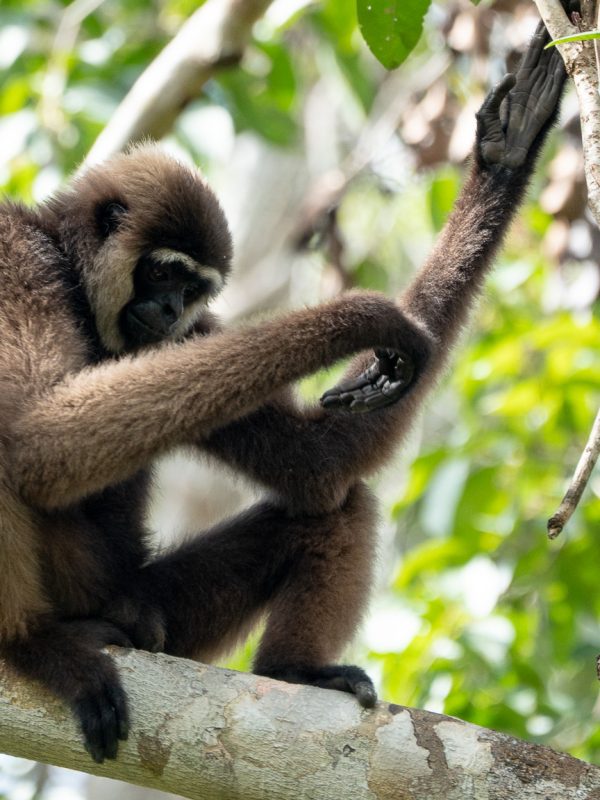
Deep inside the rainforests of Borneo, one of the most remarkable sounds you can hear is the call of a gibbon.
You may not see the animal immediately.
From somewhere high in the forest canopy comes a series of loud, rhythmic calls that seem to travel through the trees. Then, if you are lucky, you may catch a glimpse of a dark figure swinging effortlessly from branch to branch.
Gibbons are among the most agile mammals in Southeast Asia, and watching one move through the rainforest canopy is an unforgettable wildlife experience.
Borneo is home to several species of gibbons, including the Bornean agile gibbon, and they are an important part of the island’s tropical forest ecosystem.
For visitors exploring the rainforests of Central Kalimantan, hearing a gibbon calling from the forest can be just as exciting as seeing an orangutan.
What Is a Gibbon?
Gibbons are small apes that live in the tropical forests of Asia.
Unlike monkeys, gibbons are apes, meaning they belong to the same broad group of primates as orangutans, chimpanzees, gorillas and humans.
They are smaller than the great apes but are exceptionally well adapted to life in the forest canopy.
Gibbons have long arms, flexible shoulders and strong hands that allow them to move rapidly between branches.
Their primary form of movement is called brachiation.
Rather than simply climbing from branch to branch, a gibbon can swing beneath the branches using its arms, sometimes covering several metres with a single movement.
This makes them some of the most impressive acrobats in the Bornean rainforest.
Gibbons in Borneo
Borneo is home to several species and populations of gibbons.
Among the best-known is the agile gibbon (Hylobates agilis), which occurs in parts of Borneo as well as other areas of Southeast Asia.
Another important Bornean species is the Müller’s gibbon (Hylobates muelleri), which is endemic to Borneo.
Depending on where you travel on the island, the gibbon species you encounter can therefore be different.
For wildlife travellers, this makes Borneo particularly interesting. The island is not only famous for orangutans but also supports a remarkable diversity of primates.
The Agile Gibbon
The agile gibbon is one of the gibbons associated with the forests of Borneo.
It is a relatively small ape with long arms, a compact body and powerful hands.
Its body is perfectly suited to life in the canopy.
An agile gibbon rarely needs to come down to the ground. Instead, it can travel through the upper levels of the forest by swinging from branch to branch.
The speed with which it moves can be surprising.
One moment a gibbon may be sitting quietly on a branch. The next, it can disappear into the canopy with a few powerful swings.
The Sound of a Gibbon
One of the easiest ways to know that gibbons are nearby is to listen.
Gibbons are famous for their loud calls.
Their voices can carry considerable distances through dense rainforest, allowing groups to communicate across their territory.
The calls can sound almost musical, with a distinctive rhythm and pattern.
For visitors walking through a Bornean forest, hearing a gibbon before seeing one is a common and memorable experience.
Your guide may stop and point toward the canopy.
You look up.
At first, there may be nothing obvious.
Then a dark shape moves between the leaves.
This is one of the moments that makes wildlife watching in Borneo so rewarding.
Why Do Gibbons Call?
Gibbon calls serve several purposes.
One important function is communication between members of a group.
Calls can also help gibbons maintain contact across the forest and communicate information about their location.
Their vocalisations may also play a role in defending territory and maintaining social bonds.
Because the calls can travel through dense vegetation, they are particularly useful for animals living in large, three-dimensional forest environments.
In other words, the rainforest may look crowded to us, but visibility between trees can be surprisingly limited.
Sound helps bridge that gap.
Gibbons Are Highly Territorial
Gibbons generally live in relatively small family groups and maintain territories within the forest.
A group typically consists of an adult pair and their offspring, although social structures can vary between species.
The family moves through its territory looking for food and suitable sleeping and resting sites.
Their loud calls help communicate their presence to neighbouring groups.
This territorial behaviour is one reason intact rainforest is so important for gibbons.
A forest does not simply need to contain trees.
It needs to provide enough connected habitat for gibbon groups to feed, move and reproduce.
What Do Gibbons Eat?
Gibbons are primarily fruit eaters.
Fruits can make up a significant part of their diet, particularly when seasonal fruit is available.
They may also eat leaves, flowers, seeds and some insects or other small animal food.
Because gibbons spend most of their time in the canopy, they are particularly dependent on the availability of food-producing trees.
Their movements through the forest can also contribute to seed dispersal.
When gibbons eat fruit and move through the forest, they help transport seeds to different areas.
This makes them an important part of the rainforest ecosystem.
Gibbons and Orangutans
Borneo is one of the few places in the world where visitors can encounter orangutans in the wild.
Orangutans and gibbons are both apes, but their lifestyles are very different.
Orangutans are much larger and generally spend a considerable amount of time moving slowly through the canopy.
Gibbons are smaller and much more specialised for rapid movement through the trees.
An orangutan may carefully climb between branches.
A gibbon can seem to fly.
Their long arms and powerful shoulders allow them to swing rapidly through the forest.
Watching both species can give visitors a fascinating perspective on the different ways primates have adapted to life in the rainforest.
Gibbon vs Monkey: What’s the Difference?
One common question is whether a gibbon is a monkey.
The answer is no.
Gibbons are apes.
One simple distinction is that apes do not have tails, while most monkeys do.
Gibbons also have extremely long arms and specialised shoulder joints that allow them to brachiate through the canopy.
The long-tailed macaque, for example, has a prominent tail and belongs to a different group of primates.
So if you see a tailless animal swinging through the canopy with extremely long arms, you may be looking at a gibbon.
Where Can You See Gibbons in Borneo?
Gibbons live in forests across parts of Borneo, but seeing one is not always easy.
They spend most of their lives high in the canopy, where dense vegetation can make them difficult to spot.
Some protected forests and national parks provide habitat for gibbons, making them an important part of Borneo’s wildlife conservation story.
For travellers visiting Tanjung Puting National Park, the main focus is usually orangutans and the other wildlife associated with the park’s river system.
Gibbon sightings can be less predictable than sightings of some other species.
This is an important part of responsible wildlife tourism:
A wild animal encounter cannot be guaranteed.
The forest decides what you see.
Why Gibbons Can Be Difficult to Photograph
Gibbons are impressive to watch but challenging to photograph.
Their preferred habitat is high in the canopy, often far above the ground.
They also move quickly.
By the time you point your camera toward a gibbon, it may already have disappeared behind several layers of leaves.
A telephoto lens can be extremely useful, but good wildlife photography is not only about equipment.
Patience matters even more.
Sometimes the best opportunity comes when a gibbon pauses on an exposed branch before continuing through the canopy.
The Importance of Forest Conservation
Gibbons depend heavily on healthy forest habitat.
They need trees for food, shelter and movement.
Forest fragmentation can therefore create serious problems for gibbon populations.
When continuous rainforest is divided into smaller isolated areas, gibbons may have difficulty moving between suitable habitats.
Protecting large areas of connected forest is consequently important for maintaining healthy populations.
The conservation of gibbons is also connected to the conservation of many other rainforest species.
When a forest is protected for gibbons, the same forest can provide habitat for orangutans, hornbills, deer, reptiles, insects and countless plant species.
Gibbons as Indicators of a Healthy Forest
Gibbons can tell us something about the condition of a forest.
Because they depend heavily on trees and spend most of their lives in the canopy, they require a functioning forest ecosystem.
A forest capable of supporting gibbons is therefore providing more than just a collection of isolated trees.
It is providing food, shelter and connected habitat.
This is one reason why protecting Borneo’s remaining forests is so important.
The goal of conservation is not simply to preserve individual animals.
It is to preserve the ecosystems that allow those animals to live naturally.
What Should You Do If You Hear a Gibbon?
If you hear a gibbon while exploring the rainforest, don’t immediately rush toward the sound.
Stop.
Listen.
Give your eyes time to adjust to the canopy.
Look for movement rather than trying to find the entire animal immediately.
Leaves moving in an unusual way, a branch suddenly bending or a dark shape crossing between trees can reveal where the gibbon is.
And listen carefully to your guide.
Local guides often become extremely good at recognising wildlife sounds after years of working in the forest.
Sometimes they can identify a species long before visitors can see it.
Responsible Gibbon Watching
Wildlife watching should always prioritise the animals.
If you encounter a gibbon:
- Keep a respectful distance.
- Do not attempt to touch it.
- Never feed it.
- Avoid shouting or making loud noises.
- Follow your guide’s instructions.
- Do not try to attract the animal for photographs.
- Avoid disturbing sleeping or feeding animals.
The objective is not to make the animal come closer.
The objective is to observe the animal behaving naturally.
Gibbons Are More Than Just “Another Monkey”
For visitors coming to Borneo for the first time, it is easy to group all small primates together as monkeys.
But gibbons are something different.
They are apes, highly specialised for life in the forest canopy.
Their powerful arms, remarkable agility, complex social lives and distinctive songs make them one of the most fascinating animals in Southeast Asia.
And unlike many wildlife encounters, a gibbon experience often begins with sound.
You may hear the animal long before you see it.
That anticipation is part of the magic.
Gibbons and the Experience of Exploring Borneo
A journey through Borneo’s rainforest is not simply about finding a particular animal.
It is about entering an ecosystem where wildlife is constantly moving around you.
Birds call from the canopy.
Monkeys move through the trees.
Crocodiles wait along the riverbanks.
Orangutans build nests high above the forest floor.
And somewhere in the distance, a gibbon begins to sing.
For travellers visiting Tanjung Puting and other protected areas of Borneo, these moments can become some of the strongest memories of the journey.
You may come to Borneo because you want to see an orangutan.
But the rainforest will almost certainly introduce you to many other animals along the way.
The gibbon is one of them.
And once you hear that unmistakable call echoing through the forest, you will understand why.
Frequently Asked Questions About Gibbons in Borneo
Are there gibbons in Borneo?
Yes. Borneo is home to several gibbon species, including the agile gibbon and Müller’s gibbon.
What species of gibbon lives in Borneo?
Several species occur on Borneo. The exact species depends on the region. The agile gibbon (Hylobates agilis) and Müller’s gibbon (Hylobates muelleri) are among the species associated with the island.
Are gibbons monkeys?
No. Gibbons are apes. They belong to the same broad primate group as orangutans, chimpanzees, gorillas and humans.
Can you see gibbons in Tanjung Puting?
Gibbons occur in parts of Borneo’s rainforest, but sightings in Tanjung Puting should never be guaranteed. They spend much of their time high in the canopy and can be difficult to spot.
What do gibbons eat?
Gibbons primarily eat fruit, but their diet can also include leaves, flowers, seeds and small animal food such as insects.
Why are gibbons important?
Gibbons are an important part of the rainforest ecosystem. They help disperse seeds and are closely dependent on healthy forest habitat.
Why are gibbons so good at swinging through trees?
Their long arms, strong hands and specialised shoulder joints are adaptations for brachiation, allowing them to swing efficiently from branch to branch.
Listen to the Forest
Seeing a gibbon in the wild can be difficult.
Hearing one is often much easier.
So when you are travelling through the forests of Borneo, remember to look up—and listen.
The rainforest is constantly communicating.
Sometimes, one of its most beautiful voices belongs to a gibbon.