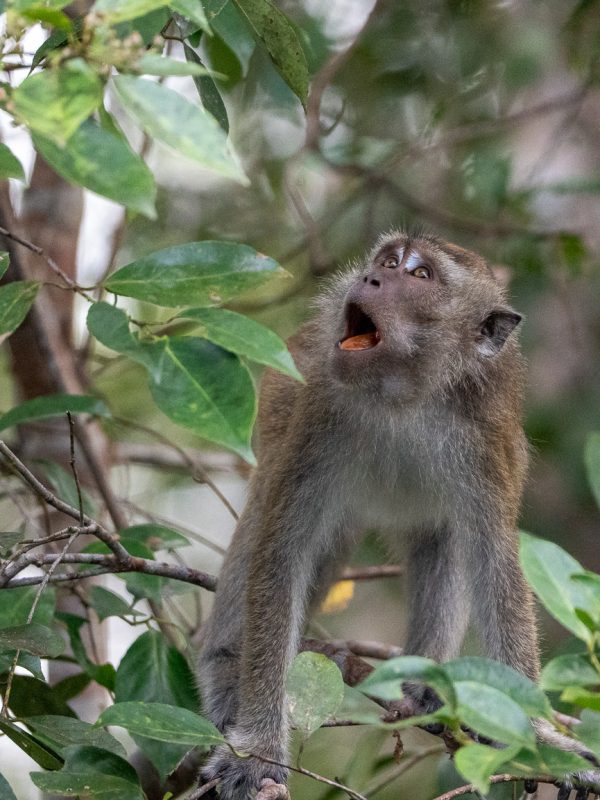
Long-tailed macaques are one of the most commonly encountered monkeys in Borneo. Along the rivers and forest edges of Tanjung Puting National Park, these agile and highly adaptable primates can often be seen climbing through trees, feeding along riverbanks, or watching passing boats from the forest.
For travellers visiting Tanjung Puting National Park in Central Kalimantan, spotting a long-tailed macaque can be one of the first wildlife encounters of the journey.
While Tanjung Puting is internationally famous for its orangutans, its rainforest is home to many other fascinating animals. The long-tailed macaque is one of them.
What Is a Long-Tailed Macaque?
The long-tailed macaque (Macaca fascicularis) is a species of monkey native to Southeast Asia. It is also known as the crab-eating macaque or cynomolgus monkey.
In Indonesia, the species is commonly called monyet ekor panjang, which literally means “long-tailed monkey.”
As the name suggests, its most distinctive feature is its long tail. The tail helps the macaque maintain balance while moving through branches and trees.
Long-tailed macaques are highly adaptable animals and can live in a variety of environments, including tropical forests, mangroves, wetlands, coastal areas and riverbanks.
This adaptability is one reason they are relatively easy to encounter during wildlife trips in Borneo.
Where Do Long-Tailed Macaques Live in Borneo?
Long-tailed macaques are widely distributed throughout Borneo.
They can be found in forests as well as areas associated with rivers and wetlands. In places such as Tanjung Puting National Park, they are particularly interesting to observe because much of the park is connected by a network of rivers and waterways.
The Sekonyer River, one of the main routes used by visitors exploring Tanjung Puting, passes through habitats where long-tailed macaques can be encountered.
From a traditional klotok boat, visitors often have a good view of the forest edge. This makes it possible to observe macaques without having to enter the forest.
Long-Tailed Macaque in Tanjung Puting National Park
Tanjung Puting is best known as one of the world’s important orangutan habitats.
However, an orangutan tour in Tanjung Puting is never only about orangutans.
The national park supports an extraordinary variety of wildlife, including proboscis monkeys, long-tailed macaques, gibbons, hornbills, kingfishers, crocodiles and many other species.
Long-tailed macaques are among the monkeys you may encounter along the river.
They are often seen close to the water, sitting on branches, moving between trees or searching for food.
Because they are active and social, a troop can sometimes be much easier to notice than a solitary forest animal.
What Do Long-Tailed Macaques Eat?
Long-tailed macaques are opportunistic feeders with a varied diet.
They can eat:
- Fruits
- Seeds
- Young leaves
- Flowers
- Insects
- Small animals
- Other available food sources
Their ability to eat a wide variety of foods allows them to survive in different environments.
Along rivers and forest edges, they may search through vegetation for fruits and other natural food.
This flexible diet is also one reason why long-tailed macaques have adapted successfully to many habitats across Southeast Asia.
Are Long-Tailed Macaques Good Swimmers?
Yes.
Long-tailed macaques are capable swimmers and are particularly comfortable around water.
This is an interesting characteristic when observing them in Borneo, where many populations live close to rivers, mangroves and wetlands.
In some situations, macaques may enter the water to move between areas, escape danger or search for food.
Their ability to move through both trees and water gives them considerable flexibility in riverine environments such as Tanjung Puting.
What Does a Long-Tailed Macaque Look Like?
Adult long-tailed macaques generally have greyish, brown or olive-coloured fur, with lighter colouring around parts of the face and underside.
Their long tail is usually the easiest feature to identify.
Young macaques are often darker than adults and stay close to their mothers.
When travelling along the river, look carefully at the branches above the water. A long-tailed macaque may blend surprisingly well into the vegetation.
Sometimes, however, a whole troop will make itself very obvious.
Long-Tailed Macaques Live in Social Groups
Long-tailed macaques are highly social animals.
They normally live in groups containing adults, juveniles and infants. Different members of the troop have different roles and relationships.
One of the most interesting behaviours to observe is grooming.
Grooming helps strengthen relationships between individuals and is an important part of social life among macaques.
Young monkeys are usually much more energetic.
They can often be seen climbing, chasing each other and playing around the branches while adults remain nearby.
If you encounter a troop during your Tanjung Puting trip, it can be worth staying for a few minutes rather than simply taking one photograph and continuing along the river.
There is often much more happening within the group.
Long-Tailed Macaque vs Proboscis Monkey
Visitors sometimes confuse the different monkeys they encounter in Borneo.
The long-tailed macaque and proboscis monkey are quite different species.
Proboscis monkeys are famous for their large noses, reddish-brown bodies and long limbs. They are strongly associated with the riverine forests and wetlands of Borneo.
Long-tailed macaques are generally smaller and have a much more adaptable lifestyle.
Both species, however, can be encountered during a river journey through Tanjung Puting.
For wildlife enthusiasts, seeing both species on the same journey is an excellent opportunity to observe how different primates share the same rainforest ecosystem.
Long-Tailed Macaque vs Orangutan
The contrast between a long-tailed macaque and an orangutan is even more obvious.
Orangutans are large great apes with reddish-orange hair and spend most of their lives in the forest canopy.
Long-tailed macaques are considerably smaller, more social and much more adaptable.
They can spend time both in trees and on the ground and are often comfortable around rivers.
Although they are very different animals, both are part of the complex rainforest ecosystem of Borneo.
This is why an orangutan tour in Tanjung Puting can produce so many different wildlife encounters.
Are Long-Tailed Macaques Dangerous?
Wild long-tailed macaques generally avoid people when they are treated with appropriate distance and respect.
However, they should never be treated like domestic animals.
Visitors should not attempt to touch them, chase them or offer them food.
Macaques are intelligent and adaptable animals. When they become accustomed to receiving food from humans, their natural behaviour can change and conflicts can occur.
For responsible wildlife tourism, the best approach is to observe them without interfering with their behaviour.
Why You Should Never Feed a Wild Macaque
Feeding wildlife may seem harmless, particularly when a monkey approaches a boat.
In reality, it can create long-term problems.
When wild macaques learn to associate humans with food, they may become increasingly dependent on artificial food sources. They can also become more comfortable approaching tourists.
This can create aggressive behaviour and increase the risk of conflict.
During a Tanjung Puting wildlife trip, allow the monkeys to find their own food.
The best wildlife encounter is one in which the animal behaves naturally.
How to See Long-Tailed Macaques in Tanjung Puting
One of the best ways to look for long-tailed macaques in Tanjung Puting is by travelling slowly along the park’s rivers.
A traditional klotok river boat provides an excellent platform for wildlife observation.
Instead of walking continuously through dense rainforest, visitors can travel quietly along the river while watching both sides of the forest.
Keep your eyes on:
- Tree branches above the river
- Forest edges
- Muddy riverbanks
- Fruit-bearing trees
- Vegetation close to the water
Your guide can also help identify animal calls and movement that might otherwise be difficult for visitors to notice.
When Is the Best Time to See Long-Tailed Macaques?
There is no guaranteed time to see wild macaques because they are free-ranging animals.
However, wildlife activity can often be rewarding during the cooler parts of the day, particularly in the morning and late afternoon.
More importantly, patience is essential.
Wildlife does not operate according to a timetable.
One moment the river may appear completely quiet. A few minutes later, a troop of macaques may suddenly emerge from the vegetation.
This unpredictability is part of the attraction of exploring Tanjung Puting.
Photographing Long-Tailed Macaques
Long-tailed macaques are excellent subjects for wildlife photography because they are active and social.
Instead of photographing only individual monkeys, look for interesting behaviour.
You may see:
- A mother carrying her infant
- Juveniles playing together
- Adults grooming one another
- A macaque feeding in a tree
- A monkey watching a passing boat
- Several members of a troop moving through the forest
A telephoto lens is useful because it allows you to photograph the animals without getting too close.
Avoid making loud noises or trying to attract the animal’s attention for a photograph.
The best wildlife photographs often happen when the animal is completely unaware of the camera.
Long-Tailed Macaques Are Part of Borneo’s Bigger Wildlife Story
It is easy to focus on famous animals when visiting Borneo.
Orangutans naturally receive much of the attention. Proboscis monkeys, hornbills and crocodiles are also popular with visitors.
But the rainforest is much more than a collection of famous species.
Long-tailed macaques are an important part of the ecosystem, and seeing them helps visitors understand how diverse Borneo’s forests really are.
Every species has a role.
Every encounter adds another piece to the story of the rainforest.
Frequently Asked Questions About Long-Tailed Macaques
What is the scientific name of the long-tailed macaque?
The scientific name of the long-tailed macaque is Macaca fascicularis.
What is a long-tailed macaque called in Indonesia?
In Indonesia, it is commonly called monyet ekor panjang.
Can you see long-tailed macaques in Tanjung Puting?
Yes. Long-tailed macaques can be encountered in suitable habitats throughout Tanjung Puting National Park, including areas along the river system.
Are long-tailed macaques found near orangutans?
Yes. Long-tailed macaques and orangutans can occur within the same broad rainforest ecosystem, although they have different behaviours and lifestyles.
Can long-tailed macaques swim?
Yes. Long-tailed macaques are capable swimmers and are comfortable living around rivers and other aquatic environments.
Should tourists feed long-tailed macaques?
No. Wild macaques should never be fed. Feeding can alter their natural behaviour and create conflicts between wildlife and people.
What should I do if I see a macaque during an orangutan tour?
Keep a respectful distance, avoid feeding or touching it, and allow the animal to continue its natural behaviour. Your guide can help you observe the troop safely.
Discover More Wildlife in Tanjung Puting
A trip to Tanjung Puting National Park is about much more than finding orangutans.
The rivers, peat-swamp forests and surrounding wetlands support an incredible variety of wildlife. Long-tailed macaques are just one of the many species you may encounter along the way.
And sometimes, the most memorable wildlife moments are the unexpected ones.
You may leave Tanjung Puting hoping to see an orangutan—and return home remembering the troop of macaques that sat beside the river and watched your klotok pass.
That is the nature of wildlife travel in Borneo.
You never completely know what is waiting around the next bend in the river.