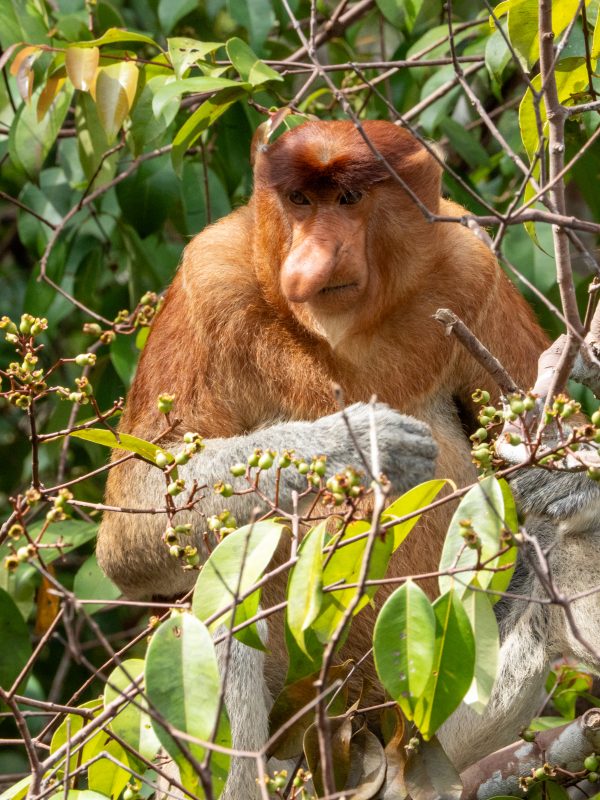
When people think about wildlife in Tanjung Puting National Park, orangutans are usually the first animal that comes to mind. But deep within the tropical forests and along the rivers of Central Kalimantan lives another fascinating Bornean species that deserves just as much attention: the proboscis monkey (Nasalis larvatus).
Known locally in Indonesia as bekantan, the proboscis monkey is one of the most distinctive primates in the world. Its large, pendulous nose, reddish-brown body, and remarkable swimming ability make it impossible to confuse with any other monkey.
For travelers exploring Tanjung Puting by traditional river boat, spotting a troop of proboscis monkeys sitting high in the trees along the riverbank can be one of the most memorable wildlife encounters of the journey.
What Is a Proboscis Monkey?
The proboscis monkey is a primate endemic to the island of Borneo. This means that it naturally occurs only on Borneo and cannot be found in the wild anywhere else in the world.
The species is particularly associated with lowland wetlands, mangrove forests, riverine forests, and other habitats close to water.
The most recognizable feature is, of course, its nose.
Adult males have an especially large, elongated nose, while females and young monkeys have considerably smaller noses. Scientists believe that the male’s large nose plays an important role in attracting females and may also amplify vocalizations.
Proboscis monkeys also have a distinctive body shape. Adult males can be considerably larger than females, and their reddish-brown fur contrasts with their pale or cream-colored faces and undersides.
Why Are They Called Proboscis Monkeys?
The word “proboscis” refers to a long, projecting nose or snout.
In Indonesia, the animal is commonly called bekantan. In some areas of Borneo, local communities have their own names and traditional knowledge associated with the species.
Their unusual appearance has made the proboscis monkey one of the most iconic animals of Borneo.
Where Can You See Proboscis Monkeys in Tanjung Puting?
One of the best ways to look for proboscis monkeys in Tanjung Puting National Park is from the river.
The park contains extensive riverine and swamp forests, creating an ideal environment for these monkeys. During a river cruise, travelers often scan the vegetation along the riverbanks for movement among the branches.
Proboscis monkeys are generally arboreal, spending much of their time in trees. However, they are also exceptionally good swimmers.
This combination of trees and waterways makes a boat journey particularly suitable for observing them.
As you travel along the river, keep an eye on both sides of the boat. A troop may appear suddenly in the trees, sometimes sitting quietly and watching the boat pass.
The Best Time to Look for Proboscis Monkeys
Proboscis monkeys can be encountered throughout the day, but early morning and late afternoon are often particularly interesting times for wildlife observation.
In the late afternoon, groups may begin moving toward their preferred sleeping trees near the river.
This is sometimes called a sleeping site or night roost.
As the sun begins to disappear over the forest, you may see groups gathering in trees close to the water. For visitors traveling by klotok, this can create a spectacular wildlife-watching experience.
The combination of golden evening light, the river, rainforest vegetation, and a troop of proboscis monkeys in the trees is one of the classic scenes of a Tanjung Puting adventure.
However, wildlife is unpredictable. There is never a guarantee that a particular animal will appear at a particular location or time.
Why Do Proboscis Monkeys Have Such Big Noses?
The enormous nose of the adult male proboscis monkey is one of the great curiosities of the animal world.
Although researchers are still studying exactly how all aspects of the nose function, it is strongly associated with communication and social behavior.
Male proboscis monkeys produce a variety of vocalizations, including loud calls that can travel through the forest. Their large noses are thought to help resonate and amplify these sounds.
The nose also appears to play a role in sexual selection, with females showing preferences related to male characteristics.
Interestingly, the nose becomes particularly prominent in adult males. Females and juveniles look quite different.
So if you see a troop of proboscis monkeys along the river, look carefully at the individuals. You may notice significant differences between adult males, females, and younger monkeys.
Proboscis Monkeys Are Excellent Swimmers
One of the most surprising things about proboscis monkeys is their ability to swim.
Unlike many other primates, proboscis monkeys are strongly associated with aquatic environments. They have partially webbed feet, which help them move through water.
When threatened, they can jump from trees into rivers and swim across the water.
This behavior makes perfect sense in the wetlands of Borneo, where rivers and waterways form an important part of the landscape.
For visitors traveling by boat, this also means that the river is not simply a transportation route. It is part of the natural habitat that makes Tanjung Puting such an interesting place for wildlife observation.
What Do Proboscis Monkeys Eat?
Proboscis monkeys are primarily folivorous, meaning that leaves make up a major part of their diet.
They also eat fruits, seeds, flowers, and other plant material depending on what is available.
Their digestive system is specially adapted to deal with a diet containing significant amounts of leaves.
This is one reason why proboscis monkeys are closely associated with particular types of forest and wetland vegetation.
While observing them, you may see individuals slowly moving through the branches and feeding on leaves.
They can appear surprisingly calm compared with some other monkey species.
A Social Animal
Proboscis monkeys live in social groups.
A typical group may contain an adult male, several females, and their young, although their social organization is more complex than this simple description suggests.
They communicate using different sounds and body movements.
During a wildlife trip in Tanjung Puting, you may hear a group before you see it.
A loud call coming from the forest can be an excellent clue that proboscis monkeys are nearby.
Their calls can be especially noticeable in the quiet environment of the river.
Proboscis Monkeys and the Bornean Ecosystem
The proboscis monkey is more than just an unusual-looking animal.
It is an important part of the wetland and riverine ecosystems of Borneo.
Because the species depends heavily on particular forest habitats, the presence of healthy proboscis monkey populations can also reflect the condition of those ecosystems.
Their preferred habitats include riverine forest, mangrove areas, peat swamp forests, and other wetlands.
Unfortunately, these habitats have experienced significant pressure from habitat conversion and other human activities across Borneo.
Protecting the forests and wetlands where proboscis monkeys live is therefore essential for the long-term survival of the species.
Proboscis Monkey vs. Orangutan: Two Very Different Bornean Primates
Tanjung Puting is famous for its orangutans, but proboscis monkeys offer a completely different wildlife experience.
Orangutans are largely solitary and spend much of their time moving through the forest canopy. Proboscis monkeys, on the other hand, are highly social and often appear in groups.
Their appearances are also dramatically different.
Orangutans are characterized by their long reddish-orange hair and powerful arms, while proboscis monkeys have reddish-brown bodies, pale faces, and the extraordinary noses of adult males.
Seeing both species during the same trip provides a fascinating introduction to the diversity of Bornean primates.
Can You See Proboscis Monkeys on an Orangutan Tour?
Yes.
A trip to Tanjung Puting National Park is not exclusively about orangutans.
While the main attraction for many visitors is following the river to orangutan rehabilitation and feeding areas such as Camp Leakey, the journey itself can provide numerous opportunities to observe other wildlife.
Proboscis monkeys are among the species that travelers may encounter along the river.
Depending on the itinerary, season, weather, river conditions, and animal movements, you may also encounter other wildlife such as macaques, leaf monkeys, hornbills, kingfishers, crocodiles, and many species of birds.
This is what makes a river journey through Tanjung Puting so special: you never know what may appear around the next bend.
The Experience of Seeing a Proboscis Monkey from a Klotok
One of the most enjoyable aspects of wildlife watching in Tanjung Puting is the traditional klotok boat experience.
Rather than traveling quickly through the forest, the boat moves slowly along the river.
This gives travelers time to observe the trees and listen to the sounds of the forest.
Your guide may suddenly point toward the riverbank:
“Bekantan!”
Everyone looks toward the trees.
At first, you may see nothing.
Then a branch moves.
A reddish-brown body becomes visible between the leaves.
And finally, the unmistakable large nose of a male proboscis monkey appears.
Moments like this are part of what makes wildlife travel in Borneo so memorable.
Responsible Wildlife Watching
When observing proboscis monkeys, it is important to maintain a respectful distance and avoid disturbing them.
Visitors should never attempt to feed wild monkeys or encourage them to approach boats.
Keeping noise levels low is also important, especially when animals are resting or feeding.
A good wildlife experience is not about getting as close as possible. It is about observing animals behaving naturally in their own environment.
Your guide plays an important role in helping you understand animal behavior and find wildlife while minimizing disturbance.
Protecting the Bekantan of Borneo
The proboscis monkey is classified as Endangered, and protecting its remaining habitat is an important conservation priority.
The species depends heavily on suitable lowland wetland and riverine habitats, many of which are vulnerable to habitat loss and degradation.
National parks such as Tanjung Puting provide important protected habitat for the species.
For visitors, choosing responsible tourism operators and following park regulations can contribute to conservation efforts.
Tourism can also help create economic incentives for protecting forests when local communities and conservation programs benefit from sustainable tourism.
Why You Should Look Beyond Orangutans in Tanjung Puting
The orangutan may be the star of Tanjung Puting National Park, but the park’s wildlife story is much bigger.
Proboscis monkeys are one of the most fascinating animals you can encounter during a river journey.
Their strange noses, social behavior, distinctive calls, and ability to swim make them uniquely adapted to the wetlands of Borneo.
And perhaps the best part is that you do not necessarily need a special expedition just to see them.
While cruising along the river on your way to explore the park’s orangutan habitat, simply keep looking at the trees.
You might suddenly discover one of Borneo’s most extraordinary primates watching you from above.
Plan Your Tanjung Puting Wildlife Adventure
A journey through Tanjung Puting National Park offers much more than an opportunity to see orangutans.
Traveling by klotok through the park’s rivers and forests allows you to experience a remarkable ecosystem where orangutans, proboscis monkeys, birds, reptiles, and many other species share the landscape.
If seeing orangutans is your primary goal, proboscis monkeys are an excellent bonus—but for wildlife lovers, they can easily become one of the highlights of the entire journey.
Ready to explore Tanjung Puting National Park?
Explore our Tanjung Puting orangutan tours and experience the forests and rivers of Borneo while searching for orangutans, proboscis monkeys, and other incredible wildlife.