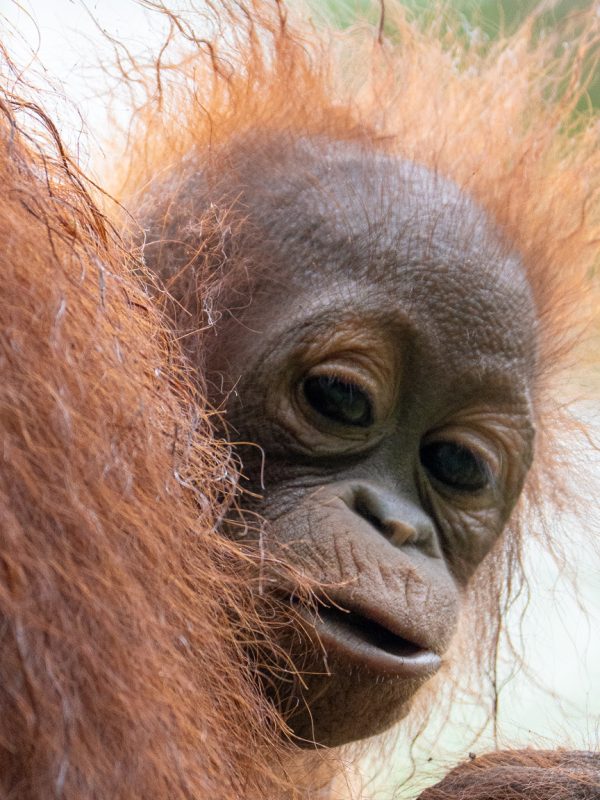
Few wildlife experiences are as emotional as seeing a baby orangutan for the first time in the rainforests of Tanjung Puting National Park or Sebangau National Park. With their curious eyes, tiny hands, and playful personalities, baby orangutans instantly capture the hearts of travelers visiting Borneo.
But behind every adorable baby orangutan is a powerful story about survival, motherhood, and the future of the rainforest itself.
At orangutantour.co, we believe that understanding these incredible animals creates a deeper and more meaningful travel experience in Borneo.
What Is a Baby Orangutan Called?
A baby orangutan is simply called an infant orangutan. Just like human babies, they stay extremely close to their mothers for many years. In fact, orangutans have one of the longest childhoods in the animal kingdom.
A mother orangutan will care for her baby for around 6 to 8 years before the young orangutan becomes independent. During this time, the baby learns everything needed to survive in the rainforest:
- How to climb trees
- Which fruits are safe to eat
- How to build nests for sleeping
- How to move safely through the forest canopy
This long learning period is one reason orangutans reproduce very slowly, making conservation even more important.
Why Baby Orangutans Are So Special


7
The word “orangutan” comes from the Indonesian and Malay words orang hutan, meaning “person of the forest.” When you watch a baby orangutan interact with its mother, the similarity to humans becomes impossible to ignore.
They laugh, sulk, play, cuddle, and learn through observation.
Travelers often describe meeting a baby orangutan as one of the most unforgettable wildlife moments of their lives.
In the wild forests of Borneo, you may see baby orangutans:
- Swinging carefully between branches
- Hiding behind their mothers when humans appear
- Playing with leaves and sticks
- Practicing climbing skills high in the canopy
Each sighting feels personal and emotional because orangutans are incredibly intelligent and expressive animals.
Where Can You See Baby Orangutans in Borneo?
The best place to see wild and semi-wild orangutans is in Indonesian Borneo, especially in:
Tanjung Puting National Park
Famous for its peaceful river cruises on traditional klotok boats, Tanjung Puting offers opportunities to visit orangutan feeding stations such as Camp Leakey, Pondok Tanggui, and Tanjung Harapan.
Many visitors are lucky enough to see mothers arriving with their babies during feeding times.
Sebangau National Park
Sebangau provides a more remote and authentic rainforest experience. Trekking through peat swamp forests gives travelers the chance to observe wild orangutans in their natural habitat.
Baby orangutans here are usually seen high in the trees, closely attached to their mothers.
Punggu Alas Area
Deep inside Sebangau, the Punggu Alas region offers one of the most immersive orangutan adventures in Borneo. The journey through blackwater rivers and untouched rainforest feels like entering another world.
Wildlife encounters here are truly special because the forest remains incredibly natural and less visited.
The Strong Bond Between Mother and Baby Orangutans


7
Mother orangutans are among the most devoted mothers in the animal kingdom.
For years, the baby rarely leaves its mother’s side. The mother carries, protects, feeds, and teaches her child every day.
Unlike many animals, orangutans usually live solitary lives. This makes the mother-baby relationship even more important because the infant depends almost entirely on its mother for survival.
Watching this bond in the wild is often the emotional highlight of an orangutan tour.
Threats Facing Baby Orangutans
Sadly, many baby orangutans lose their mothers because of:
- Deforestation
- Illegal logging
- Palm oil plantation expansion
- Forest fires
- Illegal wildlife trade
When a baby orangutan is found alone, it often means its mother has been killed.
Conservation centers and rescue organizations across Borneo work tirelessly to rehabilitate orphaned orangutans and eventually return them to the wild whenever possible.
Responsible tourism helps support these conservation efforts and provides sustainable income for local communities living near the rainforest.
How Responsible Tourism Helps Orangutans
Choosing ethical wildlife tours matters.
At orangutantour.co, we support responsible tourism by:
- Working with local guides and communities
- Supporting conservation-friendly travel
- Promoting small-scale eco tourism
- Encouraging respectful wildlife observation
- Helping travelers understand rainforest conservation
Seeing a baby orangutan in the wild should always happen without disturbing the animal or its natural behavior.
Tips for Seeing Baby Orangutans Responsibly
If you join an orangutan tour in Borneo, remember these important guidelines:
- Keep a respectful distance
- Never touch or feed wild orangutans
- Avoid loud noises
- Follow your guide’s instructions
- Do not use flash photography
- Choose eco-friendly local operators
Responsible encounters protect both wildlife and visitors.
A Memory That Stays Forever


7
There is something unforgettable about locking eyes with a baby orangutan in the middle of the Bornean rainforest.
Maybe it is their curiosity.
Maybe it is their intelligence.
Or maybe it is the reminder that the future of these forests depends on the choices humans make today.
A journey to see orangutans is more than a wildlife tour — it is a chance to connect with one of our closest relatives in one of the oldest rainforests on Earth.
If you dream of meeting orangutans in the wild, explore unforgettable rainforest adventures with orangutantour.co.